Dundee's position on the Firth of Tay means much of its development sits on soft alluvial and estuarine deposits, often underlain by glacial till at depth. These saturated, low-strength soils pose a classic challenge: high compressibility and low bearing capacity. Stone column design in Dundee must account for this layered stratigraphy, where the column's bulging failure mechanism controls the allowable load. Before any column layout is finalised, a thorough ground investigation — including the ensayo SPT at 1.5 m intervals — is essential to profile the shear strength and identify any thin lenses of peat or organic clay that could alter column performance.
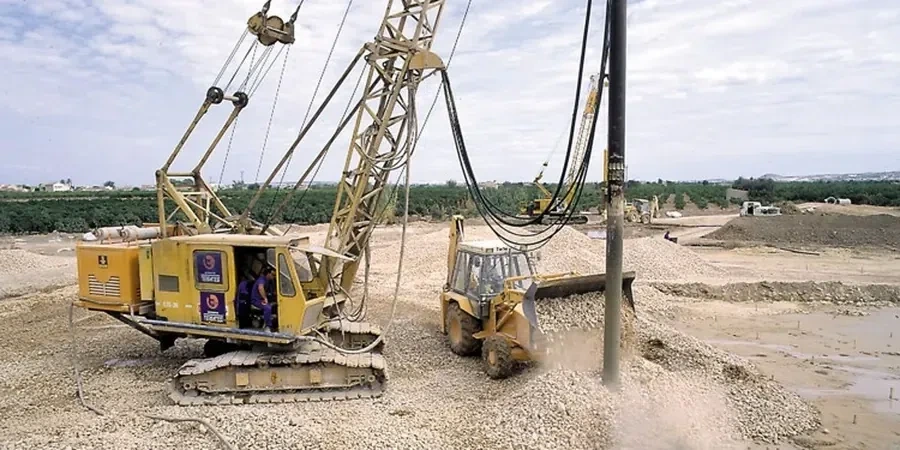
For Dundee's soft estuarine clays, stone columns typically achieve settlement reduction ratios between 2.0 and 3.5, verified against local waterfront case histories.
Process overview
Local context
Dundee's industrial expansion in the 19th and early 20th centuries saw extensive infilling of tidal creeks and former docks. These made-ground zones, particularly along the Waterfront and the eastern docks, contain variable rubble, timber, and soft organic slits. Stone column design in Dundee must anticipate these heterogeneities: a column installed through a buried timber pile or masonry fragment may knowledge local bulging or refusal. We always cross-reference the design with a detailed desk study of historical Ordnance Survey maps and borehole records from the British Geological Survey. Where obstructions are likely, a probe hole or the ensayo CPT with friction ratio logging can identify the problem horizon before installation begins.
Reference standards
BS EN 1997-1:2004 (Eurocode 7 – Geotechnical Design), BS 8006-1:2010 (Code of Practice for Strengthened/Reinforced Soils), BRE Digest 470 (Vibro Replacement – Design and Construction), CIRIA Report C573 (Vibro Stone Columns in the UK)
Additional services
Stone Column Layout Design & Optimisation
Triangular or square grid layouts optimised for the specific load requirements and soil profile. We calculate area replacement ratios, settlement reduction factors, and column bearing capacity using Priebe and Baumann methods.
Settlement & Bearing Capacity Analysis
Finite element modelling (Plaxis 2D/3D) to predict total and differential settlements under working loads. We assess column bulging, lateral displacement, and interaction effects for closely spaced groups.
Installation Specification & QA Testing
Detailed method statements covering aggregate grading, compaction energy, and trial column zones. Post-installation load testing (plate or column load) to verify modulus and confirm design assumptions.
Typical parameters
Quick answers
How much does stone column design cost in Dundee?
A typical design package — including layout calculation, settlement analysis, and specification — ranges between £1,060 and £4,240, depending on the number of load cases, column rows, and whether FEM modelling is required. This covers the geotechnical design report and installation specification.
What soil conditions in Dundee are best suited for stone columns?
Stone columns work best in soft to firm cohesive soils with undrained shear strengths between 15 and 50 kPa. In Dundee, the estuarine silts and clays along the Tay floodplain and Waterfront area fall squarely in this range. Very soft organic soils (cu < 10 kPa) may require pre-treatment with vertical drains.
How does stone column design differ for Dundee's glacial till deposits?
Where stone columns terminate in the underlying glacial till — typically a dense sandy silt with cobbles — the end-bearing component can be significant. We account for this by modelling the column as partially floating and partially end-bearing, and we check the till's SPT N-values (usually 30–50) against the allowable base pressure. The cobbles can also cause wear on the vibrator, so we specify a slightly coarser stone aggregate for the bottom 1–2 m.