Our piling rigs are a familiar sight on Dundee’s brownfield sites. The city’s industrial legacy means we often encounter made ground, old foundations and variable river terrace deposits. Before we mobilise for driven pile design, we spend a full day on site logging trial pits and recovering samples. In our knowledge, the first step is always a proper ground model — without it, you are guessing. We then correlate borehole data with the known geology of the Tay estuary to confirm pile lengths and set capacities. For deep foundations in Dundee, the combination of dense sands and soft clays demands careful analysis. We routinely run cone penetration tests to profile soil behaviour in real time, and we check groundwater conditions with permeability tests to assess dewatering needs before driving starts.
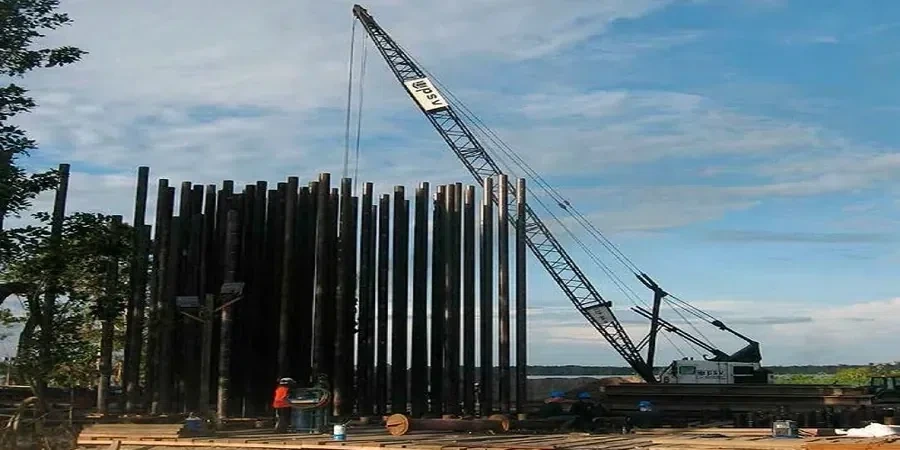
In Dundee’s variable glacial tills, a hammer energy calibration before driving can save weeks of rework on site.
Process overview
Local context
A housing development we worked on near the waterfront needed driven piles to reach competent sand at 14 m depth. During installation, the rig encountered a buried timber wharf structure that had not shown up in the desk study. That is a classic risk in Dundee: concealed obstructions from the jute and shipbuilding eras. If the pile meets refusal before reaching design depth, the load path changes. We mitigate this by specifying a sacrificial probe pile at each corner of the site and by correlating the driving records with our pile load test data from previous Dundee contracts. A dynamic pile test after the first ten piles confirms the design assumptions hold across the whole plot.
Reference standards
BS EN 1997-1:2004 (Eurocode 7 – Geotechnical design), BS 8004:2015 – Code of practice for foundations, ICE Specification for Piling and Embedded Retaining Walls (3rd edition)
Additional services
Ground investigation for piling
Rotary boreholes, SPTs, CPTs and undisturbed sampling to build a reliable soil profile for driven pile design in Dundee.
Pile design and load testing
Static and dynamic load tests, PDA monitoring, and CAPWAP analysis to verify capacity and driveability.
Geotechnical interpretative report
A comprehensive report with factored design parameters, pile layout recommendations, and construction risk assessment for your Dundee site.
Typical parameters
Quick answers
What ground conditions in Dundee most affect driven pile design?
The main challenge is the variable sequence of soft alluvial clays over dense glacial till and weathered bedrock. Pile lengths can change by several metres across one site. We always recommend a minimum of three boreholes per plot to capture lateral variability.
How much does driven pile design cost for a typical Dundee project?
For a medium-sized residential or commercial development, the design and testing package typically ranges between £900 and £3,190. This includes borehole interpretation, pile capacity calculations, and a static load test report. The final cost depends on the number of piles and ground conditions encountered.
Do you need a pile load test for every driven pile?
No. Eurocode 7 recommends one static load test per 100 piles of the same type and diameter in similar ground. For smaller Dundee sites, we often use dynamic testing on 5–10 % of the piles as a cost-effective alternative, combined with a single maintained-load test to confirm the design.