Dundee expanded rapidly during the 18th and 19th centuries, driven by jute and whaling industries. Much of the city centre was built on reclaimed land along the Tay estuary. These soft alluvial deposits and made ground create variable conditions for new foundations. Before any design work, we run a full soil classification (USCS/AASHTO) to identify material type, consistency, and drainage behaviour. This initial step determines whether the site needs a more detailed ensayo SPT for strength parameters or a permeability in situ test for water flow estimates. Without it, assumptions about bearing capacity or excavation stability can be wrong from the start.
Glacial till in Dundee varies in density and fines content within metres. A single classification per site is rarely enough.
Process overview
Local context
The field team uses hand augers and window samplers to retrieve disturbed samples from shallow pits. For deeper strata, a light percussion rig recovers split-spoon samples. Each bagged sample is labelled with depth, location, and visual description on site. Back in the lab, we wash the material through nested sieves and run Casagrande cups for plasticity. The classification sheet becomes the first page of every geotechnical report. It tells the engineer whether the ground is cohesive, granular, or organic. In Dundee's mixed geology—soft estuarine silts overlaying stiff till—misidentifying the soil type can lead to slope failures or piled foundation errors.
Reference standards
BS 5930:2015 (Code of practice for ground investigations), BS EN ISO 14688-2 (Standard Practice for Classification of Soils for Engineering Purposes - USCS), BS 1377 (Standard Practice for Classification of Soils and Soil-Aggregate Mixtures - AASHTO), Eurocode 7 (EN 1997-1:2004) – geotechnical design principles
Additional services
USCS Classification for Foundation Design
Complete USCS group symbol assignment with Atterberg limits, sieve analysis, and moisture content. Suitable for residential, commercial, and infrastructure projects. Results include a classification sheet and preliminary bearing capacity estimate.
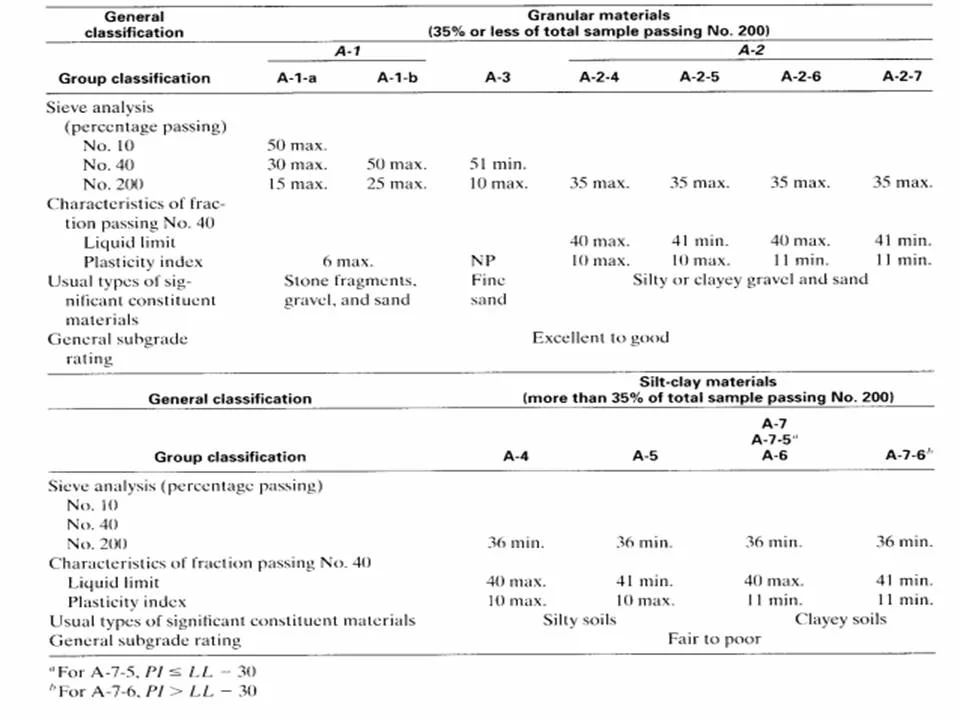
AASHTO Classification for Pavement and Roadworks
AASHTO group index calculation with full gradation curve and plasticity data. Used for subgrade evaluation, CBR estimation, and frost susceptibility assessment. Common for Dundee's road upgrades and new access roads.
Typical parameters
Quick answers
What is the difference between USCS and AASHTO classification systems?
USCS groups soils by particle size and plasticity (e.g., CL, SP, MH). AASHTO classifies for pavement design using group index, which combines fines content, liquid limit, and plasticity index. Both are useful: USCS for general geotechnical work, AASHTO for road subgrade evaluation.
How long does a soil classification test take in Dundee?
A standard classification with sieve analysis and Atterberg limits takes 5–7 working days from sample receipt. If the soil is highly organic or contains large cobbles, additional preparation may add 2–3 days. Rush requests can be arranged.
Do you need undisturbed samples for USCS classification?
No. USCS and AASHTO classifications are based on disturbed samples. You only need a bag sample of around 2 kg for sieve analysis and Atterberg limits. Undisturbed samples are required later for strength tests like triaxial or direct shear.
How much does soil classification cost in Dundee?
The typical range for a full USCS or AASHTO classification in Dundee is between £50 and £80 per sample. This includes sieve analysis, Atterberg limits, moisture content, and a final classification sheet. Volume discounts apply for multiple samples from the same site.