Dundee sits on the Tay estuary with an elevation of just 20 m above sea level. The city's geology is dominated by raised marine deposits and glacial till, which vary laterally within short distances. Our direct shear test measures the peak and residual shear strength of these soils under controlled drainage. The result is a reliable friction angle and cohesion value for your foundation or slope design. We run the test on undisturbed and remoulded specimens following BS 1377‑7:1990. Before sampling we often coordinate a calicatas exploratorias to log strata changes. This combination gives us a complete picture of Dundee's variable ground conditions. Our team has completed over 200 direct shear tests in the city's industrial and residential developments.
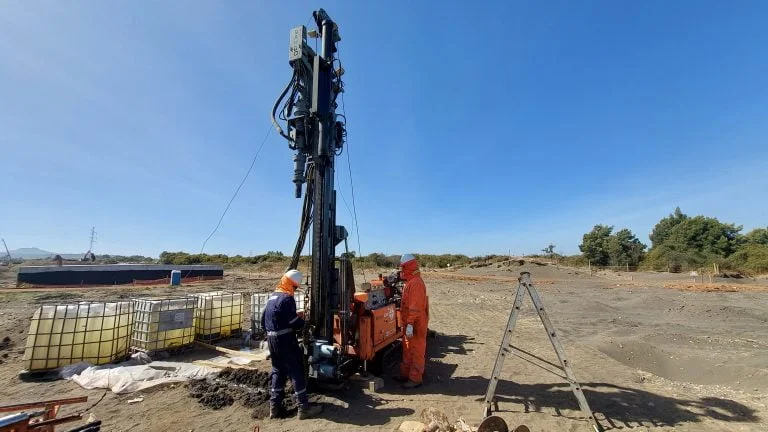
For Dundee's glacial tills, the direct shear test gives reliable friction angles and cohesion values for foundation design under Eurocode 7.
Process overview
Local context
Soils in Dundee's waterfront district are soft estuarine silts and clays with low shear strength. In contrast, the northern suburbs like Downfield sit on dense glacial till with high friction angles. Designing a retaining wall or embankment without site‑specific shear strength data can lead to unrealistic factors of safety. We have seen cases where assumed strength was 30 % higher than measured in the direct shear test. That margin is enough to cause serviceability failures or slope instability. Our test provides the actual values needed for safe, economic design.
Reference standards
BS 1377‑7:1990 – Methods of test for soils (shear strength), BS EN 1997‑2:2007 – Ground investigation and testing (Eurocode 7), BS 1377-7‑04 – Direct shear test of soils under consolidated drained conditions
Additional services
Consolidation test (oedometer)
Measures compressibility and settlement parameters for clay layers. Essential for predicting short‑ and long‑term settlement in Dundee's soft deposits.
Atterberg limits
Determines plastic and liquid limits. Helps classify soils and assess shrink‑swell potential, especially in the city's alluvial areas.
Particle size distribution
Sieve and hydrometer analysis for fine and coarse soils. Used to characterise Dundee's glacial till and estuarine silt.
Moisture content and density
Basic index properties required for any geotechnical assessment. We follow BS 1377‑2 procedures.
Typical parameters
Quick answers
How long does a direct shear test take in Dundee?
The test itself runs for 1‑3 days depending on drainage conditions. We deliver a full report with graphs and interpreted parameters within 5‑7 working days from receipt of samples.
What is the difference between direct shear and triaxial tests?
The direct shear test forces a failure along a predefined plane, which is representative of many field conditions. The triaxial test allows failure on the weakest plane and gives undrained strength. We recommend direct shear for granular soils and simple stability analyses.
How much does a direct shear test cost in Dundee?
Our standard rate for a set of three specimens is between £560 and £670. The final cost depends on the number of specimens, drainage condition, and urgency. We offer a fixed quote before work starts.