We recently worked on a mixed-use development near Dundee's waterfront, where the ground conditions shift from soft alluvial silts to dense glacial till within a few metres. That project demanded a continuous soil profile to avoid missing weak layers beneath the proposed tower footprint. The CPT (Cone Penetration Test) proved ideal because it records tip resistance and sleeve friction every 20 mm, giving us a near-continuous log of stratigraphy. Before moving to detailed design, we often pair the CPT with a georradar survey to detect buried obstacles or old foundations, and with dilatometer testing where lateral stress history is critical for retaining walls. In Dundee, where the Tay estuary deposits create variable soil lenses, this combination catches hidden risks that isolated boreholes might miss.
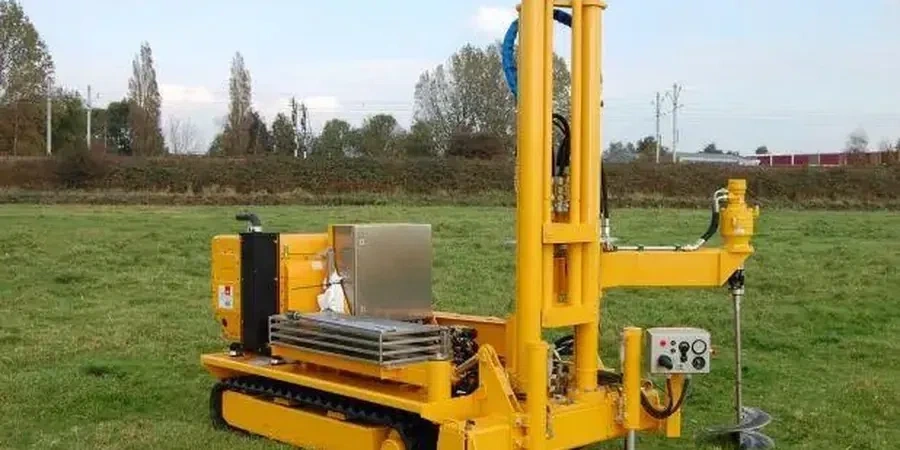
The CPT delivers a continuous soil profile at 2 cm intervals, catching thin weak layers that SPT blow counts can easily skip.
Process overview
Local context
Dundee's geology includes soft estuarine clays and sandy gravels overlying Devonian sandstone, with the water table often less than 3 m below ground along the Firth of Tay. These conditions create a real risk of undetected soft pockets beneath stiff crust layers. If a foundation design assumes uniform bearing capacity based only on shallow test pits, a thin clay lens at 6 m depth could trigger differential settlement of 15–20 mm across a building footprint. The CPT's continuous profile catches those lenses directly, and the measured pore pressure dissipation gives us the in-situ coefficient of consolidation (cv and ch) without waiting days for lab tests.
Reference standards
BS EN ISO 22476-1:2012 (Cone Penetration Test), Eurocode 7 (EN 1997-1:2004) – Part 1: General rules, BS 5930:2015 – Code of practice for ground investigations
Additional services
Standard CPT with Pore Pressure (CPTu)
Full cone penetration with u2 pore-pressure measurement, providing continuous qc, fs, and u2 profiles. Includes real-time data display and a final report with soil behaviour type classification (Robertson 1990 chart). Suitable for most foundation and infrastructure projects in Dundee.
Advanced CPT with Seismic Module (SCPTu)
Adds a seismic source at the surface and a geophone inside the cone to measure shear-wave velocity (Vs) at 1 m intervals. Critical for liquefaction assessment, dynamic foundation design, and site classification per Eurocode 8. Recommended for Dundee's seismic microzonation studies.
Typical parameters
Quick answers
How deep can the CPT reach in Dundee's glacial till?
In the densest glacial till layers typical of Dundee's northern suburbs, our 20-tonne rig can normally penetrate to 25–30 m. Where cobbles or boulders are present, we may stop earlier or switch to a sacrificial cone tip. We always assess refusal risks during the site walkover.
What is the typical cost range for a CPT in Dundee?
For a standard CPTu to 20 m depth, expect between £110 and £220 per metre, including mobilisation within the Dundee urban area. The final price depends on site access, total linear metres, and whether pore-pressure dissipation tests are required. We offer a fixed quote after a quick site check.
How does the CPT compare to SPT for foundation design in Dundee?
The CPT gives a continuous profile, so it catches thin weak layers that SPT blow counts might skip. For Dundee's interbedded sands and clays, we often run both: CPT for continuous stratigraphy and SPT for direct correlation with bearing capacity formulae. The two methods complement each other well.
Can the CPT be used for liquefaction assessment in the Tay estuary?
Yes, the CPT is the preferred method for liquefaction evaluation because it measures tip resistance (qc) and sleeve friction (fs) continuously. When combined with shear-wave velocity from our seismic CPTu module, we can apply the Robertson & Wride (1998) method to estimate cyclic resistance ratio (CRR) directly for Dundee's estuarine deposits.