Dundee expanded rapidly during the 19th-century jute boom, filling tidal flats with variable fill to extend the waterfront. That legacy of made ground over soft estuarine silts demands careful soil mechanics study before any new foundation work. The city’s underlying Old Red Sandstone bedrock dips gently southward, creating a wedge of glacial till that thickens toward the Tay. A thorough investigation combines borehole logging with SPT and CPT soundings to map the transition from fill to competent till. Where historical contamination is suspected, we integrate chemical testing into the soil mechanics study to meet NHBC and planning conditions. This layered approach ensures that every recommendation — from shallow footings to deep piled solutions — is backed by site-specific data rather than regional assumptions.
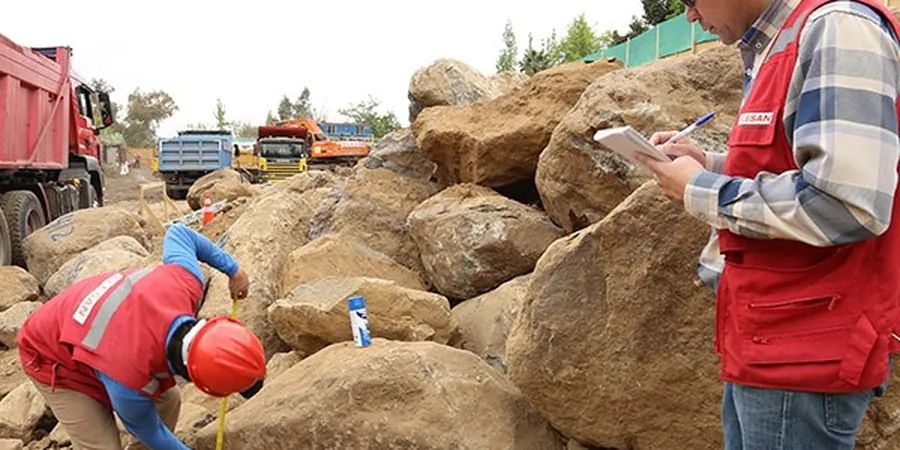
A soil mechanics study in Dundee must map the transition from variable fill to dense glacial till and assess liquefaction susceptibility in waterfront zones.
Process overview
Local context
The drill rigs used in Dundee are tracked hydraulic units with 4 m rod lengths, chosen to navigate the narrow closes of the city centre and the steep slopes near the Law. On reclaimed land along the Tay, the rig must be matted to spread the 20‑tonne load and prevent sinking into soft fill. The biggest operational risk is striking unexpected boulders in the till, which can stall SPT sampling and damage cone penetrometers. To mitigate this, we run a pre‑bore with a heavy tri‑cone roller bit when surface evidence suggests cobble layers. Our soil mechanics study protocol also includes continuous core recovery in the upper 5 m of fill to identify any buried structures or voids that could cause differential settlement later.
Reference standards
BS 5930:2015 – Code of practice for ground investigations, Eurocode 7 (EN 1997-1:2004) – Geotechnical design, BS EN ISO 22476-3 – Standard test method for SPT, BS EN ISO 22475-1:2006 – Sampling by drilling
Additional services
Field Borehole Logging & SPT
Continuous core logging with SPT at 1.5 m intervals. We classify strata according to BS 5930 and measure N-values to estimate relative density and strength. This forms the backbone of any soil mechanics study in Dundee.
Lab Strength & Consolidation Testing
Triaxial CU and UU tests on undisturbed till samples, plus oedometer consolidation to determine pre‑consolidation pressure. Results feed directly into settlement calculations for strip footings and rafts.
Liquefaction Screening (Waterfront Sites)
Using SPT-based methods from Youd & Idriss (2001) and cyclic stress ratios derived from seismic hazard analysis. Required for any soil mechanics study on filled ground within 200 m of the Tay estuary.
Typical parameters
Quick answers
How deep should a soil mechanics study be in Dundee for a typical three-storey building?
For a three-storey structure on glacial till, boreholes should extend at least 5 m into competent strata or to refusal on bedrock. In waterfront areas where fill exceeds 3 m, we recommend penetrating 2 m into the underlying till to confirm its bearing capacity.
What is the typical cost range for a soil mechanics study in Dundee?
A standard residential investigation with two boreholes to 10 m depth and basic lab testing falls between £2.770 and £4.100. Larger commercial sites with multiple boreholes, groundwater monitoring, and advanced triaxial testing can exceed £6.000.
Does the soil mechanics study need to consider tidal groundwater fluctuations?
Yes. Groundwater levels in the waterfront zone can vary by up to 1.5 m with spring tides. Our study includes standpipe installations and at least one month of weekly monitoring to establish the highest seasonal groundwater table, which is critical for basement waterproofing design.