Dundee grew rapidly during the jute and whaling industries of the 19th century, pushing development onto the steep slopes overlooking the Tay and onto reclaimed tidal land. That legacy means many properties sit on made ground, glacial till, or weathered sandstone at shallow depth. Designing a retaining wall here requires site-specific soil parameters, not textbook assumptions. We combine on-site investigation with laboratory testing to define those parameters. Before placing any wall, we recommend a study of the bearing capacity to confirm the founding layer can support the imposed loads without excessive settlement.
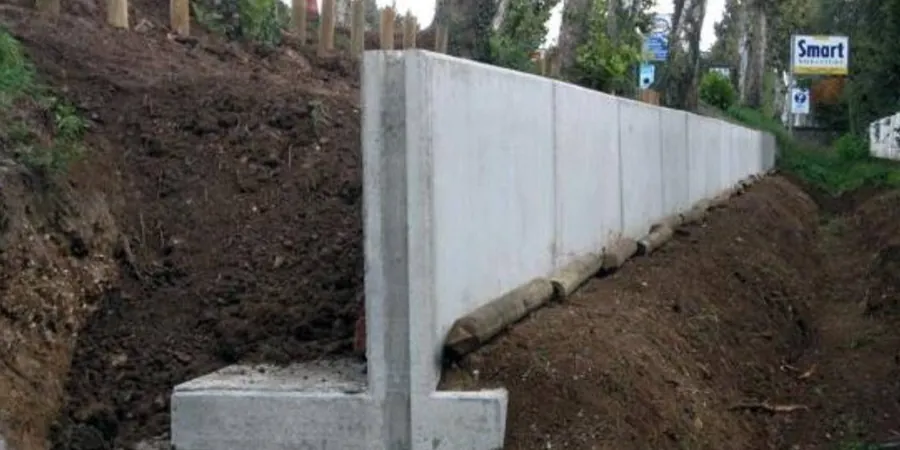
Glacial till in Dundee can contain boulders up to 0.5 m. A wall designed without confirming the soil profile risks local instability and costly redesign.
Process overview
Local context
Eurocode 7 (BS EN 1997‑1:2004) is the mandatory design framework in the UK, and it is especially relevant in Dundee because of the variable ground conditions across the city. A wall designed without a ground investigation may underestimate the water pressure behind the stem — particularly after heavy rainfall on the Sidlaw slopes. We always check for perched water tables and include a drainage layer with a factor of safety against hydrostatic build‑up. Our reports reference the local geological mapping from the British Geological Survey (Sheet 49W) and include a risk register for each wall.
Reference standards
BS EN 1997‑1:2004 (Eurocode 7 – Geotechnical design), BS 8002:2015 (Code of practice for earth retaining structures), Highways England CD 350 (Highway retaining walls — design and assessment)
Additional services
Design of gravity and cantilever walls
For walls up to 4 m high in the glacial till and raised beach deposits common around the city centre and Broughty Ferry. We calculate sliding, overturning, bearing pressure, and global stability using LimitState GEO or Oasys Slope. Output includes reinforcement schedules and drainage details.
Design of anchored and MSE walls
For taller walls or constrained sites such as the Dundee Waterfront regeneration area. We design soil nails, ground anchors, and mechanically stabilised earth (MSE) walls with geogrid reinforcement. Each design includes a corrosion assessment for the anchor tendons per BS 8081.
Typical parameters
Quick answers
How much does retaining wall design cost in Dundee?
A typical design package for a residential or small commercial wall costs between £800 and £2.840, depending on wall height, soil complexity, and the number of design checks required. A full ground investigation adds cost but reduces risk.
What ground conditions in Dundee most affect retaining wall design?
Glacial till with cobbles and boulders, made ground from historic infill, and variable water tables on the slopes above the Tay. These conditions require careful selection of soil parameters and often a phased investigation — SPTs first, then undisturbed sampling for triaxial testing.
Do I need a site investigation before designing a retaining wall in Dundee?
Yes. Without a ground investigation you cannot assign reliable characteristic values for Eurocode 7. We recommend at least two trial pits or boreholes per wall, with SPTs every 1.5 m, plus laboratory tests for shear strength and Atterberg limits.