A common mistake we see on Dundee sites is relying solely on end bearing calculations for piles driven into the dense glacial till that underlies much of the city. While the till can offer high toe resistance, it often masks significant shaft friction variability caused by cobble layers and boulder inclusions. Our team has logged dozens of boreholes across Dundee where refusal on a single cobble gave misleading SPT N-values, leading to overdesigned foundations. Before specifying pile lengths, we always run a full skin friction vs. end bearing separation using load test data and CPT profiles. Complementing this with a CPT probe helps identify thin sand lenses that alter shaft resistance, while a direct shear test on the till matrix provides the friction angle needed for beta-method calculations.
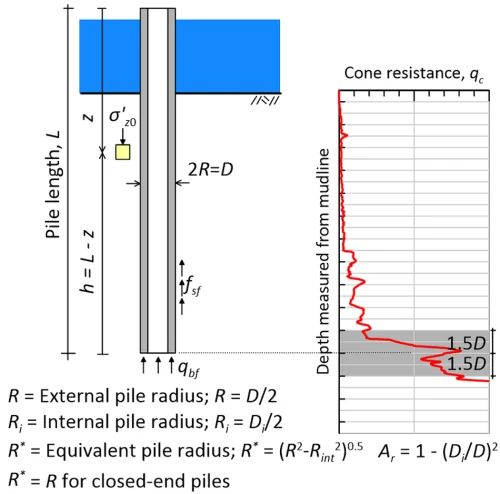
In Dundee, shaft resistance often contributes 60–75% of total pile capacity in driven piles, yet many designs ignore it entirely.
Process overview
- Interface friction angle from ring shear tests on till-concrete interfaces
- Effective stress profile accounting for groundwater at 3–5 m depth in the Tay valley
- Cobble content from wash bore logs to adjust alpha and beta coefficients
Local context
Eurocode 7 (BS EN 1997-1:2004) requires that pile design consider both ultimate limit state and serviceability limit state separately — a distinction that becomes critical in Dundee because the glacial till can strain-soften under cyclic loading. In older buildings along the Perth Road, we have documented cases where end bearing alone was calculated but differential settlement occurred due to shaft friction degradation in cobble-rich zones. Ignoring skin friction variability in Dundee can lead to either uneconomical overdesign or, worse, progressive failure under eccentric loading. Our analysis always includes a sensitivity study on the alpha and beta methods per the ICE Specification for Piling.
Visual overview
Reference standards
BS 5930:2015 Code of practice for ground investigations, BS EN 1997-1:2004 Eurocode 7 – Geotechnical design, ICE Specification for Piling and Embedded Retaining Walls (3rd Ed.)
Additional services
Instrumented Static Load Test (ISLT)
Full-scale compression test with strain gauges and tell-tales at multiple levels to separate shaft and toe resistance. Includes interpretation per Chin-Kondner and Davisson criteria, with reporting in BS EN 1997-1 format.
CAPWAP Dynamic Testing & Signal Matching
High-strain dynamic testing on driven piles using Pile Driving Analyzer (PDA) equipment. Provides skin friction distribution and end bearing mobilisation in real time, calibrated against local Dundee till databases from over 50 test piles.
Typical parameters
Quick answers
What is the typical cost range for a pile skin friction vs. end bearing analysis in Dundee?
For a standard project in Dundee, the cost typically falls between £880 and £2,540 depending on pile type, number of test piles, and instrumentation depth. This includes field testing, laboratory triaxial and interface shear tests, and a full design report with ULS/SLS checks. Larger developments with multiple pile groups may be quoted at the lower end per pile.
How does Dundee's glacial till affect the skin friction component compared to end bearing?
Dundee's glacial till has a high cobble and gravel content that creates a rough pile-soil interface, giving shaft friction values of 80–160 kPa in driven piles. However, the presence of boulders can cause local refusal during driving, reducing end bearing mobilisation to only 30–50% of calculated toe capacity. In bored piles, the smear zone from augering can cut skin friction by half, so end bearing becomes dominant.
Which Eurocode 7 design approach is most appropriate for piles in Dundee?
We recommend Design Approach 2 (DA2) from BS EN 1997-1:2004 for Dundee sites, as it applies separate partial factors to actions and resistances. The glacial till's stiffness requires a high Model Factor (γ_R,d = 1.4) when using empirical methods like the alpha or beta method. For serviceability, the settlement criterion should be set at 10 mm under working load based on local load test records.