The glacial till and raised marine deposits that underlie much of Dundee present a highly variable subgrade for road construction. Along the Kingsway corridor, for example, we routinely encounter stiff boulder clay with cobbles that can give deceptively high in-situ strength, while closer to the Tay estuary soft silty clays dominate. A reliable CBR study for road design in Dundee must account for this lateral variability and the effect of the high water table that persists through winter months. Before running soaked CBR tests we always correlate with calicatas exploratorias to log the soil profile and identify any buried organic layers that could compromise long-term pavement performance. The results guide both the pavement thickness design and the selection of stabilisation treatment where the CBR falls below 2.5 percent.
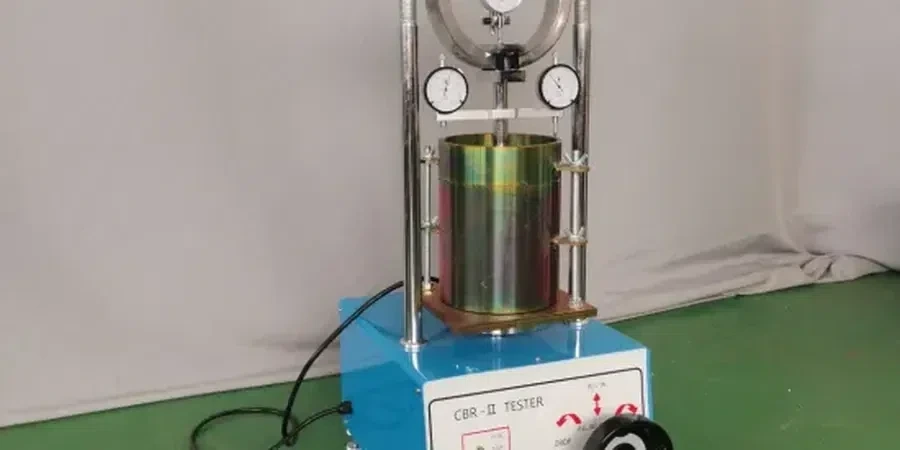
The soaked CBR values for Dundee's alluvial terraces typically range between 1.8 and 4.5 percent, requiring a capping layer on most new alignments.
Process overview
Visual overview
Reference standards
BS 1377-4:1990 — Methods of test for soils for civil engineering purposes: Compaction-related tests (CBR), BS 1377-9:1990 — In-situ tests (plate bearing and CBR), DMRB CD 225 — Design for new pavement foundations (formerly HD 25), Eurocode 7 (EN 1997-1:2004) — Geotechnical design: limit state approach for subgrade verification
Additional services
Laboratory Soaked CBR Test
Compact soil samples at standard or modified Proctor energy, soak for 96 hours, and measure penetration resistance at 2.5 and 5.0 mm. Reporting includes load-penetration curve and design CBR value per BS 1377-4.
In-Situ CBR by Plate Bearing
Field test using a 150 mm or 300 mm diameter plate with hydraulic jack and dial gauges. Performed at formation level to verify the as-compacted subgrade strength before pavement layers are placed. Follows BS 1377-9.
Correlation with DCP (Dynamic Cone Penetrometer)
Rapid profiling of subgrade strength every 100 mm using a 20 kg hammer. DCP index is correlated to CBR using the Kleyn formula, allowing continuous coverage of long road alignments at low cost.
CBR-Based Pavement Thickness Design
Using the design CBR value and traffic loading (million standard axles), we calculate the required thickness of subbase, roadbase, and surfacing layers following DMRB CD 225 or Road Note 29 methodology.
Typical parameters
Quick answers
What is the typical CBR value for subgrade soils in Dundee?
In our laboratory testing the soaked CBR for Dundee's glacial till ranges from 3.0 to 6.5 percent, while the soft alluvial silts along the Tay estuary typically give 1.8 to 3.2 percent. The in-situ unsoaked values can be 2 to 3 times higher, but we always design on the soaked condition to account for winter moisture rise.
How much does a CBR study for road design in Dundee cost?
A standard laboratory soaked CBR test on one sample at five moisture contents costs between £140 and £280, depending on the number of compaction points and whether the sample is undisturbed or remoulded. An in-situ plate bearing test including mobilisation within Dundee city limits is typically £220 to £350 per test point.
When should I use a soaked CBR test instead of an unsoaked one?
We recommend the soaked test for all pavement subgrade evaluations in Dundee because the water table is rarely deeper than 1.5 m in the city's lower areas. The 96-hour soak represents the worst-case spring condition when the subgrade is saturated. Unsoaked tests are only appropriate for granular subgrades that drain freely or for temporary works with a short design life.
How many CBR test points are needed for a road project in Dundee?
For a typical residential street of 400 m we suggest one laboratory CBR per 100 m of alignment, plus one in-situ plate test per stratum change. For major roads like the Kingsway or the A92 we increase the frequency to one test per 50 m and add DCP profiling between test locations to capture the spatial variability of the glacial till.