Dundee sits on the Firth of Tay, where glacial and fluvial deposits create a complex subsurface. The city has experienced several minor seismic events, the most notable being the 1868 magnitude 4.8 earthquake near Perth. Loose saturated sands and silts are common along the river terraces, making soil liquefaction analysis a critical step before any deep foundation or embankment design. We assess cyclic resistance ratios using standard penetration test data, complemented by a cone penetration test when continuous profiling is needed. Our team follows the NCEER 2001 procedure and the Youd-Idriss method to produce site-specific assessments.
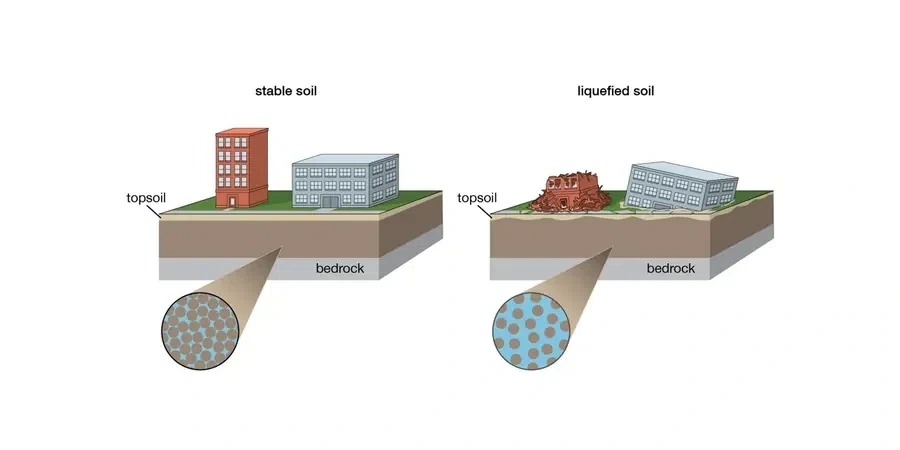
Loose saturated sands along the Tay estuary require site-specific cyclic resistance ratios — generic correlations often overestimate safety.
Process overview
Local context
The population of Dundee exceeds 148,000, and much of the urban expansion occurred on reclaimed land along the waterfront. The 1868 Perth earthquake had an epicentre less than 30 km away, and although the magnitude was moderate, it caused ground cracking in loose sands near the river. A repeat event today could trigger extensive liquefaction in the Dock Street and Riverside areas, where fill materials and soft estuarine deposits overlie dense till. Our analysis identifies these zones and quantifies the probability of lateral spread and settlement. We cross-reference historical damage reports with current borehole data to validate the models.
Reference standards
BS 5930:2015 – Code of practice for ground investigations, Eurocode 7 (EN 1997-2:2007) – Geotechnical design, site investigation, BS 1377/D5311M-13 – Cyclic triaxial test for liquefaction, NCEER 2001 (Youd & Idriss) – SPT-based liquefaction evaluation
Additional services
SPT-based liquefaction screening
Field SPT with energy measurement, fines correction, and CSR/CRR calculation per NCEER 2001. Includes factor of safety profiles to 20 m depth.
Cyclic triaxial testing
Undisturbed samples tested under cyclic loading at 0.1–1 Hz to determine cyclic resistance and pore pressure generation curves.
Resonant column and shear modulus
G/Gmax and damping ratio curves at small strains (0.0001–0.1%), essential for deformation analysis in liquefied soils.
Liquefaction potential index (LPI)
Depth-integrated severity mapping using LPI and Ishihara's criteria for surface manifestation prediction in urban areas.
Typical parameters
Quick answers
How is soil liquefaction analysis performed in Dundee?
We follow the NCEER 2001 method using SPT blow counts corrected for overburden and energy. Fines content is determined by wet sieving, and the cyclic stress ratio is calculated from the design earthquake magnitude and peak ground acceleration. For critical structures, we supplement with cyclic triaxial tests on undisturbed samples.
What is the cost range for a liquefaction study in Dundee?
The typical cost ranges between £2,230 and £3,590 depending on the number of boreholes, sample disturbance requirements, and whether cyclic triaxial testing is included. A detailed quote is issued after reviewing the site plan and required depth.
Which soil types in Dundee are most prone to liquefaction?
Loose to medium dense sands and silty sands with a fines content below 35% are most susceptible. These are common in the river terrace deposits along the Tay and in reclaimed areas near the waterfront. Dense glacial till and bedrock are not liquefiable.
Does your laboratory hold UKAS accreditation for these tests?
Yes, our laboratory is UKAS accredited to ISO 17025 for SPT energy measurement and cyclic triaxial testing. All reports include traceable calibration certificates and are signed by the responsible engineer.