We worked on a five-storey extension beside the Tay estuary where the underlying soft alluvial clay reached 12 m depth. The original foundation solution would have required driven piles at 18 m, but the client wanted a faster programme and less vibration near a listed building. By developing a jet grouting design that treated the upper 8 m of saturated silt and clay, we created a stiffened block that reduced settlement to 15 mm under service loads. Before finalising the treatment grid we ran a cone penetration test to map the thin sand lenses that could affect grout column continuity, and we used vibrocompaction as a complementary densification method in the deeper granular layers. The result was a Improvement scheme that saved three weeks on the programme and eliminated the need for temporary sheet piling.
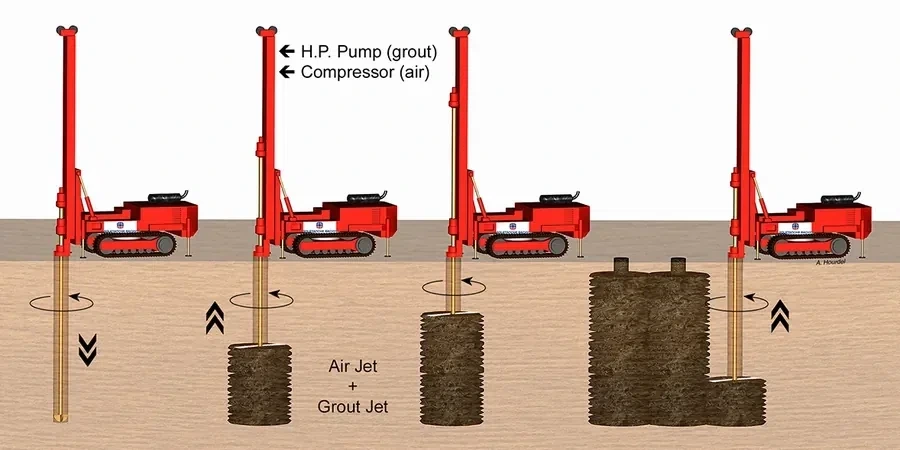
We verify each column with continuous monitoring of flow, pressure and return grout density – no assumption goes unchecked.
Process overview
Local context
Dundee’s position on the Firth of Tay means the water table is often less than 2 m below ground in the city centre and can fluctuate with spring tides by 0.5 m. High pore pressures in the soft alluvial silt reduce the effective confining stress, which can cause the jet grout column to neck during the lifting phase if the withdrawal rate is not adjusted. We mitigate this by running a pre‑treatment piezometric survey and, where artesian conditions are suspected, installing temporary relief wells. Another recurrent issue is the presence of cobbles and boulders in the glacial till that can deflect the monitor – we therefore require a georadar survey ahead of the jet grouting design to map obstructions and adjust the drilling layout accordingly.
Reference standards
BS EN 12716:2018 – Execution of jet grouting works, Eurocode 7 (EN 1997-1:2004) – Geotechnical design, CIRIA C573 – Jet grouting: a guide for civil engineers
Additional services
Jet Grouting for Foundation Improvement
Design of mono‑ and double‑fluid jet grout columns to increase bearing capacity and reduce settlement in soft alluvial clays, peat lenses and made ground. Includes column layout optimisation, treatment depth verification and post‑treatment coring validation.
Jet Grouting for Hydraulic Cut‑offs & Excavation Support
Design of continuous jet grout panels and bottom plugs to control groundwater inflow during deep excavations. We integrate the design with temporary works (anchors, props) and check the hydraulic gradient against internal erosion criteria.
This service complements our laboratory testing work for a complete project analysis.
Typical parameters
Quick answers
What is the typical cost of a jet grouting design in Dundee?
For a medium-sized project (200–500 columns) the design fee including parametric study, column layout, verification plan and reporting typically ranges between £1.230 and £4.770, depending on ground variability and the number of treatment levels. Larger schemes with multiple fluid systems or deep obstructions may fall above this band.
How deep can jet grouting columns be installed in Dundee’s glacial till?
We have successfully treated depths up to 28 m in the Dundee Formation sandstone, but in the overlying glacial till with cobbles the practical limit is around 15 m with a double‑fluid system. Beyond that, rod deviation becomes difficult to control and the risk of column discontinuity rises.
Does jet grouting work in the soft alluvial clays near the Tay?
Yes, but the high plasticity and low permeability of the alluvial clay (plasticity index often > 35 %) require a slower withdrawal rate and a higher water/cement ratio to avoid clogging the monitor. We design the treatment parameters based on site‑specific triaxial and permeability tests, not on default values.
What post‑treatment verification do you recommend for jet grout columns?
We specify continuous coring of at least 5 % of the columns plus unconfined compression tests on the recovered cores. For hydraulic cut‑offs we add falling‑head permeability tests in boreholes drilled through the panel. If the design relies on tensile capacity, we also request pull‑out tests on selected columns.