Dundee sits on the north bank of the Firth of Tay, where the underlying geology shifts from raised marine deposits in the city centre to glacial till and bedrock as you move north toward the Sidlaw Hills. That transition makes sheet pile wall design a site-specific challenge — a wall that works near the V&A will not suit a site in Broughty Ferry. In our knowledge, the key variable here is the presence of soft alluvial clays and loose sands that can reach 15 metres deep along the waterfront. Before committing to a wall type, we always run a cone penetration test (CPT) to map soil layering continuously. That data feeds directly into the design model.
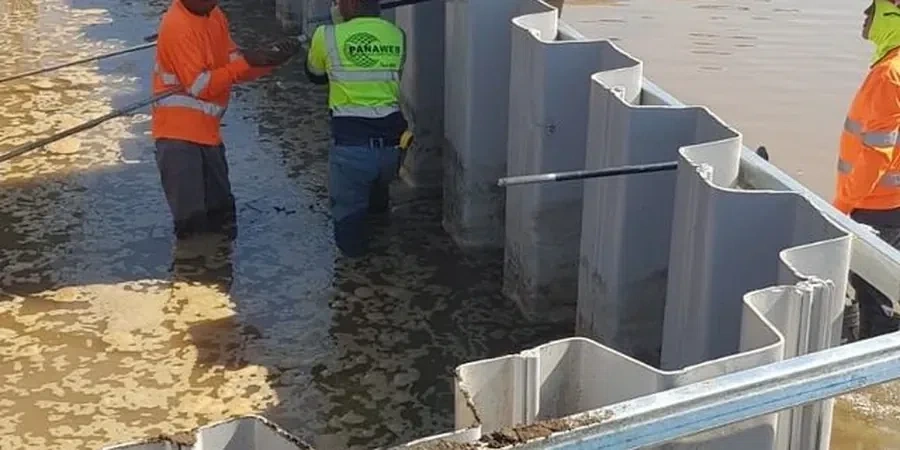
In Dundee's soft alluvial soils, hydrostatic pressure often governs the design more than lateral earth pressure alone.
Process overview
Local context
The most common mistake we see in Dundee is underestimating the effect of tidal drawdown. When the Tay drops at low tide, the water level on the excavated side of the wall falls faster than the groundwater behind it can drain. That temporary imbalance can double the net pressure on the wall face. Several local projects in the Riverside Drive area have had to add extra anchorage mid-construction because the design assumed steady-state conditions. We always run a transient seepage analysis as part of the sheet pile wall design to check that the wall can handle the full tidal cycle, not just the worst-case steady water level.
Reference standards
BS EN 1997-1:2004 (Eurocode 7 – Geotechnical Design), UK National Annex to BS EN 1997-1:2004, CIRIA C760 – Guidance on embedded retaining walls, BS 6349-2:2019 – Maritime works: Design of quay walls, jetties and dolphins
Additional services
Ground Investigation for Retaining Walls
Fieldwork including rotary core drilling through the sandstone, SPT tests in the granular layers, and installation of standpipe piezometers to monitor tidal fluctuations. The boreholes target the critical failure planes identified in the desk study.
Structural Design & Anchorage Verification
Using finite-element software (Plaxis 2D) to model wall-soil interaction under both drained and undrained conditions. We check bending moments, deflection limits, and passive resistance, then produce a design package ready for temporary works coordination.
This service complements our laboratory testing work for a complete project analysis.
Typical parameters
Quick answers
What is the typical cost range for sheet pile wall design in Dundee?
For a standard waterfront retaining wall up to 6 m retained height, the design fee including ground investigation and structural calculations ranges between £1.290 and £4.530. Larger schemes with multiple wall types or complex tidal modelling fall at the upper end of that band.
How does the Tay estuary affect the design of permanent sheet pile walls?
The tidal range in the Tay exceeds 4.5 m at spring tides, which creates cyclic loading on the wall. Over time, that repeated pressure fluctuation can loosen granular backfill behind the wall if the drainage layer is not specified correctly. We design the drainage stone and weep holes to handle the full tidal cycle without clogging.
Do I need a separate corrosion assessment for a sheet pile wall in Dundee?
Yes, especially for permanent walls. The saline environment of the Tay estuary accelerates corrosion in the splash zone. BS EN 1993-5 requires a corrosion allowance based on the exposure zone, and we typically specify an additional 2 mm to 3 mm on the exposed face for a 50-year design life.
Can sheet piles be driven into the Old Red Sandstone found in parts of Dundee?
Direct driving into the sandstone is rarely feasible because the rock is moderately strong (UCS 30 – 60 MPa). We usually pre-drill a pilot hole to the required embedment depth and then drive the pile into the pre-formed hole, backfilling the annulus with grout to restore lateral restraint.