Our team mobilises a full suite of remediation equipment across Dundee, from mobile soil-washing plants to ex-situ bioremediation platforms. For a former gasworks site near the Firth of Tay, we recently deployed auger-based stabilisation units to treat heavy-metal hotspots. This direct-approach capability means we can handle chlorinated solvents, petroleum hydrocarbons, and arsenic contamination without subcontracting. Every job starts with a phased investigation, often combining a density cone sand test for compaction control with targeted soil sampling. We work to BS 5930 and the CLR 11 framework, ensuring each remediation strategy aligns with the site's end-use and local planning conditions.
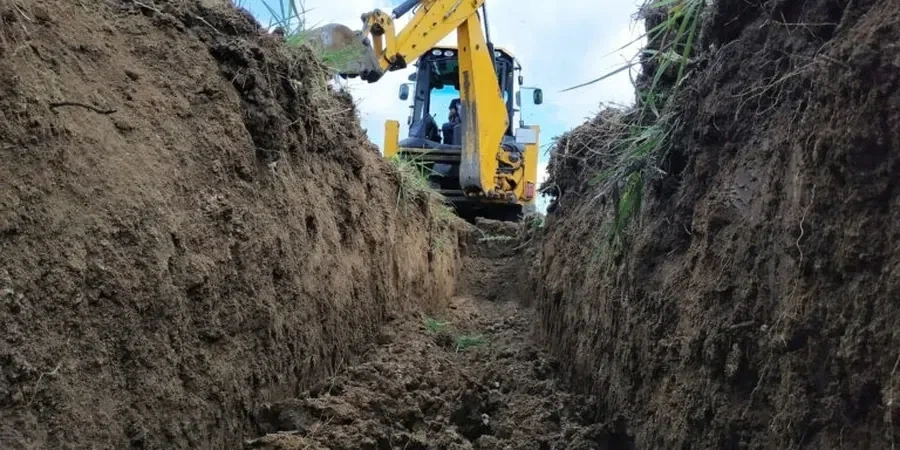
Dundee's contamination profiles shift dramatically within the same postcode – we tailor every strategy to the specific soil matrix and regulatory framework.
Process overview
Local context
Dundee sits on a mix of raised beach deposits, alluvial silts, and made ground from its industrial past. The 2021 Tay Cities Region Deal has spurred major brownfield redevelopment, but many sites contain legacy contamination from jute processing, shipbuilding, and chemical works. If not remediated properly, contaminants can migrate into the Firth of Tay or affect groundwater used for public supply. We have seen cases where uncontrolled excavation spread arsenic-laden dust across nearby residential areas. Our team mitigates this through real-time dust monitoring, vapour barriers, and phased capping plans that meet the NHBC and SEPA standards.
Reference standards
BS 5930:2015 (Code of practice for ground investigations), CLR 11 (Model Procedures for the Management of Land Contamination), SEPA’s WAT-PS-10 (Remediation targets for controlled waters), BS EN 1997-1:2004 (Eurocode 7 – Geotechnical design)
Additional services
Ex-situ soil stabilisation and solidification
Excavation, screening, and mixing of contaminated soil with binders such as cement, lime, or activated carbon to immobilise contaminants. We validate each batch with leachate testing per BS EN 12457. Suitable for heavy metals and semi-volatile organics.
In-situ bioremediation via oxygen injection
Designed for petroleum hydrocarbons and BTEX compounds in Dundee’s silty sands. We install injection wells at 3–5 m spacing and monitor dissolved oxygen, pH, and microbial activity over 8–16 weeks. Final verification follows SEPA’s WAT-PS-10 criteria.
Typical parameters
Quick answers
What does contaminated soil remediation in Dundee typically cost?
The cost for a typical brownfield site in Dundee ranges between £2,660 and £9,400, depending on the contaminant type, volume of soil, and chosen treatment method. A site-specific quotation is always recommended.
How long does a remediation project take?
Timescale depends on the method. Ex-situ stabilisation usually takes 2–4 weeks for a 500 m³ batch. In-situ bioremediation can run 8–16 weeks because of the biological degradation rate. We always offer a schedule during the scoping phase.
Do you handle asbestos-contaminated ground in Dundee?
Yes. We follow the Control of Asbestos Regulations 2012 and use licensed contractors for removal. Asbestos cement, loose fibres, and soils with >0.1% asbestos are segregated and disposed of at permitted facilities in Scotland.
What certification does your lab hold?
Our laboratory is UKAS accredited under ISO 17025 for the analysis of PAHs, TPH, heavy metals, and more. All validation data is traceable and accepted by SEPA for site closure reports.
Can you remediate soil under an existing building?
We can. Options include in-situ bioremediation via directional injection points, vapour intrusion barriers, or sub-slab depressurisation systems. A structural assessment is completed first to protect the foundation.