Dynamic compaction design in Dundee must account for the city's complex ground conditions. Much of the land along the Tay estuary and the Waterfront regeneration area sits on deep fills, soft alluvial deposits, and former industrial yards. Eurocode 7 (BS EN 1997-1:2004) provides the limit state framework for determining drop weight, grid spacing, and number of passes. Before designing the treatment pattern, we review historical maps and borehole logs to locate buried foundations or activities. On many Dundee sites, the fill thickness exceeds 6 m, making heavy tamping a cost-effective alternative to excavation. We also correlate the target relative density with CPT cone resistance to verify improvement depth during trials.
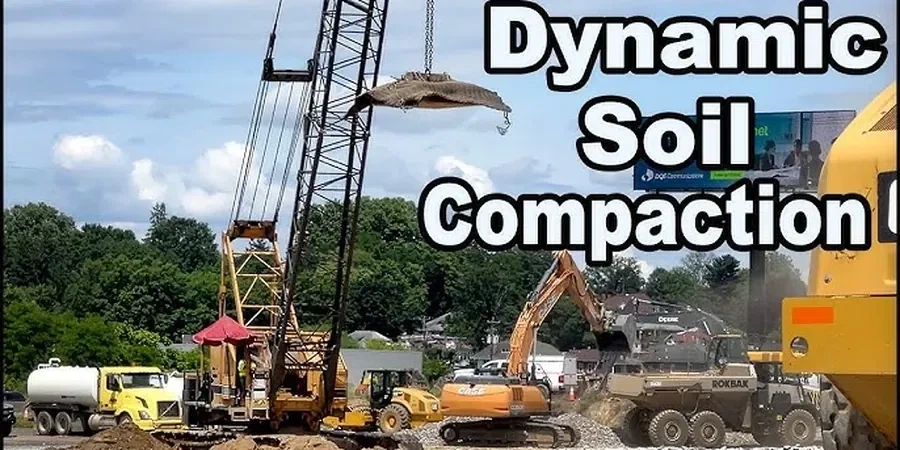
On Dundee's waterfront, a 15 t tamper dropped from 18 m treated 4 m of granular fill in under three weeks.
Process overview
Local context
Dundee sits at sea level along the Firth of Tay, with a population of around 150,000. The city has no significant seismic history, but the main geotechnical risk is variable fill. A poorly designed compaction program can leave soft lenses that cause differential settlement under pavements or foundations. We mitigate this by performing a pre-treatment CBR trial and post-treatment plate load tests. On brownfield sites, buried obstructions can damage the tamper or create shadow zones. A GPR survey ahead of dropping helps locate anomalies. Our dynamic compaction design in Dundee always includes a trial zone with cone penetration tests before scaling to full production.
Reference standards
BS EN 1997-1:2004 (Eurocode 7 – Geotechnical design), BS 5930:2015 (Code of practice for ground investigations), BS EN ISO 22476-3 (Standard test method for SPT)
Additional services
Dynamic Compaction Specification & Supervision
We write the method statement, define tamping parameters, and supervise the drop sequence on site. Includes settlement monitoring, trial zone testing, and a post-treatment acceptance report.
Site Investigation for Compaction Design
Boreholes, CPT, and dynamic probes to characterise fill thickness, moisture content, and obstructions. The data feeds directly into the energy calculation and grid layout.
Typical parameters
Quick answers
How much does dynamic compaction design cost in Dundee?
A typical design package including site investigation, parameter selection, and supervision support ranges from £1.120 to £3.450, depending on site area, fill depth, and access constraints. Larger sites with trial zones fall at the higher end.
What ground conditions in Dundee respond best to dynamic compaction?
Granular fills and loose sands with less than 20% fines respond very well. Cohesive or wet fills require pre-drainage or alternative methods. The Tay-side alluvial deposits with high water table may need wick drains before tamping.
Can dynamic compaction be used near existing buildings in Dundee?
Yes, with vibration monitoring and reduced energy passes. We typically set a peak particle velocity limit of 15 mm/s at the nearest structure. For sensitive sites, we switch to a lighter tamper or use a pre-formed crater to attenuate waves.