Dundee sits on a deep sequence of soft estuarine clays, silts, and occasional peat lenses laid down by the Tay estuary. These soils exhibit high compressibility and low undrained shear strength, often below 25 kPa at shallow depths. Prefabricated vertical drain design in Dundee must account for the layered stratigraphy and variable pore pressure response. We combine site-specific data from boreholes with consolidation testing on undisturbed samples to calibrate the coefficient of consolidation (c_v) and radial drainage (c_h). This avoids the common pitfall of over-estimating settlement rates when using generic design charts alone.
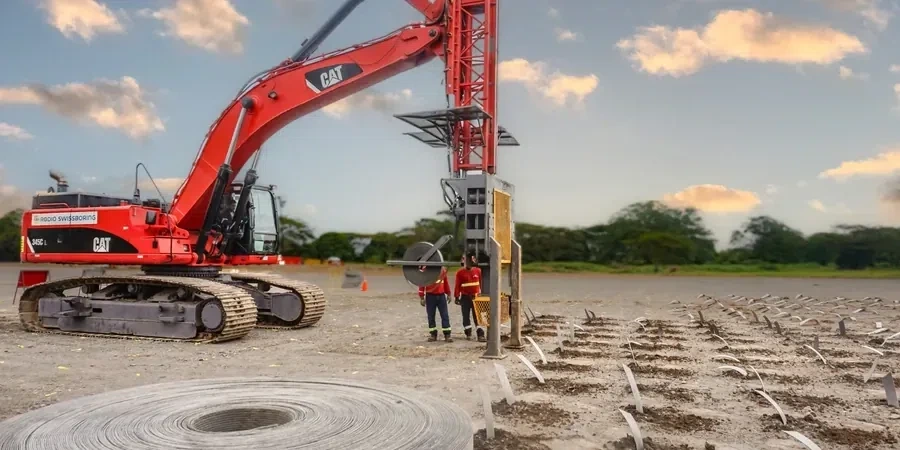
In Dundee's soft estuarine clays, radial drainage through prefabricated vertical drains can cut primary consolidation time from years to months when spacing is optimised with site-specific c_h values.
Process overview
Local context
A common error on Dundee sites is to assume uniform clay behaviour across the full depth. Ignoring the interbedded silt and fine sand layers leads to over-drainage predictions in the upper zone while the deeper soft clay remains under-consolidated. We have seen embankments on the Myrekirk and Riverside sites suffer differential settlement because the drain design did not account for the lower c_h in the deeper laminated clays. Proper prefabricated vertical drain design in Dundee requires a depth-variable consolidation model, not a single average value.
Reference standards
BS EN 1997-1:2004 (Eurocode 7 – Geotechnical design), BS 5930:2015 (Code of practice for ground investigations), CIRIA C760 (Guidance on vertical drains for Improvement)
Additional services
Drain spacing optimisation
Parametric analysis using Barron and Hansbo solutions to determine triangular or square grid spacing that meets the required degree of consolidation (U > 90%) within the available preload period.
Smear zone assessment
Quantification of mandrel-induced soil disturbance using in-situ CPT or vane shear profiles, adjusting the reduced radial permeability for more realistic settlement-time curves.
Surcharge load design
Determination of temporary embankment height and preloading duration to achieve post-construction settlement targets below 25 mm, accounting for staged loading and undrained stability.
Instrumentation and verification
Deployment of settlement plates, piezometers, and inclinometers to monitor pore pressure dissipation and surface heave during drain installation and surcharge periods.
Typical parameters
Quick answers
What soil conditions in Dundee most benefit from prefabricated vertical drains?
The soft alluvial and estuarine clays along the Tay estuary, particularly where natural drainage paths are blocked by silt laminations or peat layers. Sites near the waterfront, such as Riverside or the Port area, typically show consolidation times reduced by 60–80% with properly spaced PVDs.
How does the shallow water table in Dundee affect PVD installation?
A water table at 1.5 to 3 m depth means the mandrel must displace saturated soft ground, which can cause temporary heave and remoulding. We account for this by increasing the smear zone diameter in the design and specifying a slower penetration rate (below 0.3 m/s) to minimise soil disturbance.
What is the typical range for band drain spacing in Dundee projects?
For embankment and tank farm projects, we commonly specify triangular grids with spacing between 1.2 m and 2.5 m. Tighter spacing (1.2–1.8 m) is used where the clay is thicker (>12 m) or the available surcharge period is limited to less than 6 months.
How do you verify that the PVD design is working during construction?
We install vibrating wire piezometers at mid-depth between drains and settlement plates at the ground surface. Pore pressure readings are plotted against Asaoka's method to confirm that the coefficient of consolidation matches the design value. If dissipation is slower than expected, we recommend additional drains or extended surcharge time.