Many local contractors in Dundee underestimate the risk of shallow translational slides on the steep banks of the Dighty Burn or along the Law. A slope that appears stable after a dry summer can fail catastrophically during a wet winter. We see this repeatedly: the ground looks firm, but the pore pressure builds up behind a clay layer, and suddenly a 5-metre section of the embankment gives way. That is why we always pair the slope stability analysis with a proper ensayo de penetración estática (CPT) to map those thin, saturated clay lenses that trigger failure. The analysis itself follows the limit-equilibrium method outlined in Eurocode 7, but the real value comes from understanding Dundee's specific soil layering.
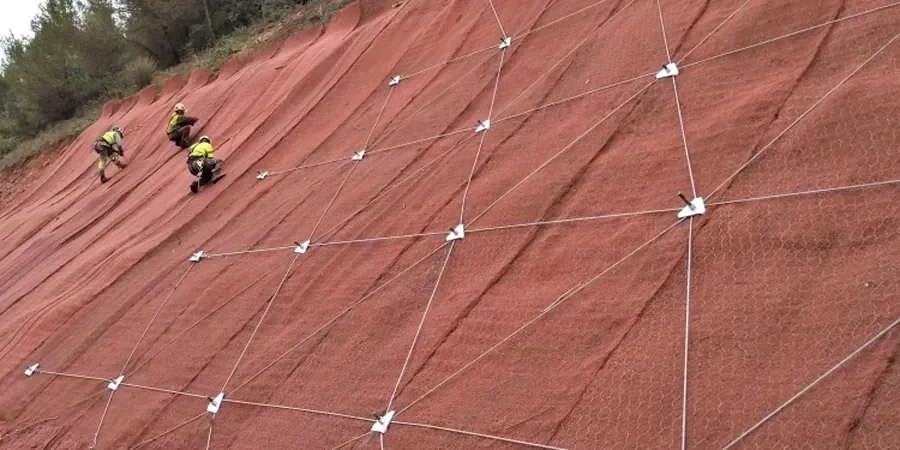
A factor of safety below 1.3 in Dundee's glacial till means the slope will move within two winter cycles.
Process overview
Local context
A housing development on the northern slope of Balgay Hill ran into trouble two years ago. The contractor cut a 6-metre-high face to level the building platform, but left the unsupported slope exposed for three months. After a week of persistent rain, a shallow wedge slid about 4 metres into the excavation. The cause was straightforward: the clay had softened, the pore pressure rose, and the factor of safety dropped to 1.1. The fix involved removing the failed material, installing a drainage blanket, and re-compacting the backfill. A proper slope stability analysis before the cut would have flagged that risk. The repair cost more than the original ground investigation. That is the kind of scenario we help clients avoid in Dundee.
Reference standards
Eurocode 7 (EN 1997-1:2004), BS 5930:2015 (Code of practice for ground investigations), FHWA-NHI-05-088 (Slope stability reference manual)
Additional services
Limit-Equilibrium Analysis (Bishop / Morgenstern-Price)
For most cut slopes and embankments in Dundee, a 2D limit-equilibrium analysis is sufficient. We model up to three slip surfaces per section and calculate the factor of safety under drained and undrained conditions. The output includes a sensitivity graph showing how the safety factor changes with water table depth. Typical deliverable: a technical report with cross-sections, parameters table, and recommended mitigation.
Finite-Element Analysis (Shear Strength Reduction)
When the slope geometry is complex or there are existing retaining structures, we switch to a finite-element model using Plaxis 2D. This captures stress redistribution and progressive failure. We use it for the steep ravines near the Dighty Burn and for railway embankments where deformation limits are tight. The analysis gives both the safety factor and the displacement field.
Typical parameters
Quick answers
What is the typical cost of a slope stability analysis in Dundee?
A standard limit-equilibrium analysis for a single slope section typically ranges between £1.020 and £2.960, depending on the number of sections, the complexity of the soil profile, and whether laboratory testing is included. For a full finite-element study with two scenarios, the price sits at the upper end of that range.
How deep should the boreholes be for a slope analysis in glacial till?
We recommend boreholes extending at least 1.5 times the height of the slope below the toe, or to a depth where a competent stratum is found. In Dundee's till, a 10-metre borehole is usually enough for a 6-metre-high cut. The key is to sample the clay below the potential slip surface.
Do you use the residual or peak strength for long-term stability?
For first-time slides in undisturbed till we use the peak strength parameters. But if the slope shows signs of previous movement — slickensides or shear zones — we switch to the residual friction angle. The decision depends on the site history and the presence of pre-existing shear surfaces identified during the borehole logging.