We run the SPT with a 63.5 kg drop hammer falling 760 mm onto a split‑barrel sampler. The rod string is 54 mm AWJ. In Dundee, the rigs are tracked to handle the steep slopes of the Law and the soft alluvium of the Tay floodplain. Each test records blow counts per 150 mm interval. We log N‑value, seating drive, and refusal criteria on site. The data feeds directly into bearing capacity and liquefaction assessments. Before mobilising, we check access for the tripod or drill rig — some residential streets near Broughty Ferry are narrow. The SPT gives us a continuous soil profile in glacial till, river terrace gravels, and made ground. It is the backbone of most foundation reports in the city. We also combine it with a calicata exploratory pit for visual logging.
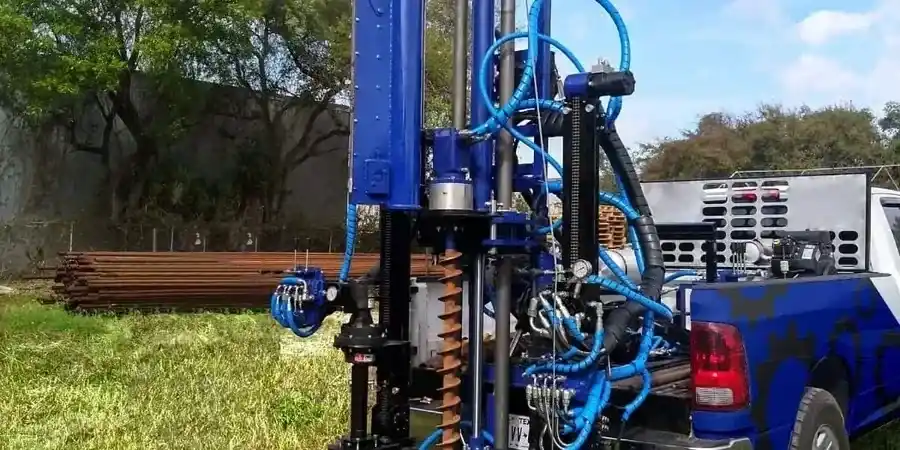
A single SPT profile in the Tay floodplain can reveal 8 m of soft clay over dense gravel — critical for pile length decisions.
Process overview
Local context
Dundee sits at sea level on the Firth of Tay. The water table is high in the city centre — often 1–2 m below ground. Loose granular fills and soft organic silts are prone to liquefaction during seismic events, even moderate ones. The SPT N‑value is the input for the Youd‑Idriss liquefaction triggering curves. In the Dock Street area, N‑values below 5 are common in the top 4 m. That means Improvement or deep foundations are mandatory for multi‑storey buildings. We also see lateral spreading risk near the waterfront. Running the SPT to 15 m depth gives us the full stratigraphy to assess settlement and bearing failure. The test is the only in‑situ method that delivers a soil sample and a strength index in one operation.
Reference standards
BS EN 1997‑2:2007 (Eurocode 7 – Ground investigation and testing), BS 5930:2015 (Code of practice for site investigations), BS EN ISO 22476-3‑18 (Standard Test Method for SPT)
Additional services
Standard SPT Drilling (Open‑hole)
Tripod or track‑mounted rig with continuous SPT at 1.5 m intervals. Suitable for glacial till and river terrace deposits. Includes sample retrieval and on‑site logging. N‑values reported with energy correction.
SPT with Sampling in Soft Ground
Extended barrel and liner for cohesive soils. Blow counts recorded every 150 mm. We retrieve undisturbed tube samples alongside the SPT for laboratory triaxial and consolidation tests.
SPT for Liquefaction Assessment
Dedicated profile to 15 m in the floodplain and reclaimed areas. N‑values input into cyclic resistance ratio (CRR) curves. Report includes fines content correction and factor of safety against liquefaction.
Typical parameters
Quick answers
What is the typical cost for an SPT in Dundee?
For a single borehole with SPT at 1.5 m intervals to 10 m depth, expect between £420 and £580. The range depends on access, number of tests, and whether sampling is required. We offer a fixed price per borehole after a site walkover.
How deep should the SPT go in the Tay floodplain?
We recommend a minimum of 12 m in the floodplain. The soft alluvium extends to about 8 m, underlain by dense gravels. Pile design requires N‑values in the bearing stratum, so we push the test into the gravel until 50 blows per 150 mm is recorded.
Can the SPT detect buried obstructions like old foundations?
Yes. A sudden increase in blow count followed by a drop often indicates a buried slab or masonry. We log the refusal depth and correlate it with historical maps. If an obstruction is suspected, we stop the SPT and switch to a ground‑penetrating radar survey to map the anomaly before continuing.