The contrast between Dundee's volcanic sill foundations in the city centre and the deep alluvial deposits along the Tay estuary creates very different seismic responses. In the West End, buildings sit on hard basalt with natural periods below 0.2 seconds. Over in Stannergate or Broughty Ferry, soft estuarine clays and sands can amplify long-period shaking. An HVSR microtremor survey at the site pinpoints the fundamental resonance frequency before design starts. We combine this passive method with a CPT sounding to correlate stiffness at depth, giving the structural engineer a clear picture of how the ground will behave during an earthquake.
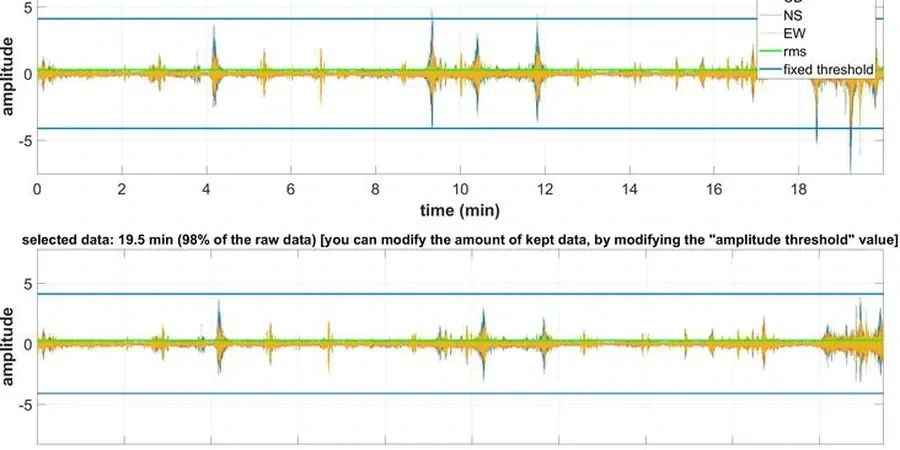
A single HVSR station measures ambient noise for 20–30 minutes and yields the site's fundamental frequency, a parameter no borehole can give directly.
Process overview
- Peak frequency (f0) — typically 0.5–8 Hz for Dundee soils
- Amplification factor — ratio between soil and rock motion at resonance
- Vs30 estimate from frequency and depth of impedance contrast
Local context
Dundee lies in a low-seismicity region, but the 2011 Mw 3.6 event near Perth reminded engineers that small earthquakes can cause damage if the ground amplifies motion. The city's population of roughly 148,000 includes critical infrastructure: Ninewells Hospital, the V&A Dundee, and the Tay Road Bridge. Without an HVSR microtremor survey, design spectra may underestimate site amplification in soft zones. Eurocode 7 and BS EN 1998-1 require site-specific seismic response for consequence class 3 structures. We deliver the data needed to define ground type A, B, C, D, or E with confidence.
Reference standards
BS EN 1998-1:2004 (Eurocode 8) — seismic site classification, SESAME project guidelines (2004) — HVSR acquisition and processing criteria, NEHRP site class definitions (FEMA P-749)
Additional services
Single-Station Survey
One 30-minute recording at a strategic location. Ideal for small extensions or initial screening. Delivers f0 and amplification factor with basic H/V curve.
Multi-Point Grid Survey
8 to 12 stations across the site. Produces a contour map of resonant frequency and Vs30 zonation. Recommended for housing developments or commercial blocks on variable ground.
Integrated Seismic Response Study
Combines HVSR with borehole data, MASW profiles, and laboratory dynamic testing. Outputs site-specific elastic response spectra for structural design per Eurocode 8.
Typical parameters
Quick answers
How does an HVSR microtremor survey work in an urban area like Dundee city centre?
The sensor records ambient vibrations from traffic, wind, and industrial activity. The Nakamura method separates the vertical from horizontal components to isolate the site's resonance. Urban noise is actually beneficial — it provides a broad frequency signal. We deploy the instrument on pavement or grass away from large trees and underground activities. Processing in GEOPSY software removes transient spikes from nearby construction or trains.
What is the cost range for an HVSR survey in Dundee?
A single-station survey typically runs between £600 and £900 including equipment and reporting. A multi-point grid covering an average housing plot costs £1.160 to £2.210 depending on the number of stations and site access. The integrated study with borehole correlation is quoted per project. Prices vary with travel distance and reporting complexity.
Can HVSR replace a traditional borehole investigation?
No, HVSR is complementary, not a replacement. It gives the site's natural frequency and a Vs30 estimate but does not offer soil classification, strength parameters, or groundwater levels. We recommend combining HVSR with at least one borehole or CPT for stratigraphic control. The two datasets together give a far more reliable seismic ground model than either alone.