On a typical Dundee site, our team deploys vibrating-wire piezometers and in-place inclinometer arrays to capture real-time ground behavior. We install these sensors using hollow-stem auger rigs or direct-push methods depending on the till and alluvial deposits beneath the city. Before mobilising, we review the borehole logs and cross-check them against historical maps of the Tay estuary. The setup usually takes two to three days, and we run baseline readings for 24 hours before the contractor starts any excavation. This gives the design team confidence in the initial data.
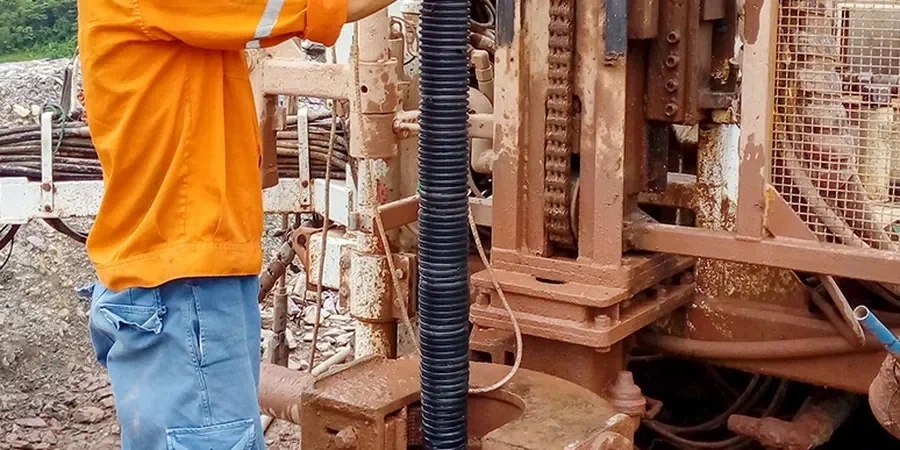
Combining vibrating-wire piezometers with MASW profiles gives a complete stiffness and pore-pressure picture before excavation starts.
Process overview
Local context
Dundee receives around 700 mm of rain a year, and the water table can rise quickly after a wet winter. If we install piezometers too late, the contractor might start dewatering without knowing the actual pore pressure distribution. That can lead to bottom heave in a deep excavation or differential settlement of adjacent buildings. Our instrumentation design includes a trigger alarm: when the pore pressure exceeds a predefined threshold, the system sends an SMS to the project manager. This early warning gives them time to adjust the dewatering rate before any damage occurs.
Reference standards
BS EN 1997-2:2007 (Eurocode 7 – Ground investigation and testing), BS 5930:2015 (Code of practice for site investigations), ISO 17025:2017 (Laboratory accreditation for sensor calibration)
Additional services
Pore-pressure monitoring
Vibrating-wire piezometers installed in boreholes or driven tips, connected to a datalogger with hourly readings. Ideal for retaining walls and deep basements where the till layer controls seepage.
Inclinometer arrays
Continuous or traversing probe inclinometers in ABS casing, grouted into the borehole. We set the baseline before any load is applied, then measure at intervals defined by the movement rate.
Settlement and heave systems
Hydraulic settlement cells and rod extensometers placed at founding level and at intermediate strata. We reference every reading to a stable benchmark outside the zone of influence.
Typical parameters
Quick answers
When should I install piezometers in a Dundee site?
As soon as the borehole logs are complete and before any bulk excavation starts. The glacial till holds water in discontinuous lenses, so early readings help size the dewatering system accurately.
How often should inclinometer readings be taken?
During the active construction phase we recommend weekly readings. Once movement stabilises, monthly intervals are usually sufficient. Our cloud loggers can automate the schedule if needed.
What is the typical cost range for a full instrumentation package?
For a medium-size site (six to ten piezometers, four inclinometers and two settlement cells) the range is approximately £1.960 – £2.960 including installation and one month of monitoring. The final price depends on the number of sensors and the depth of the boreholes.
Do you calibrate the sensors on site?
The reference range for this service in Dundee is £1.960 - £2.960. The final price depends on the project scope and volume.