Ground improvement in Dundee represents a critical branch of geotechnical engineering focused on enhancing the mechanical and hydraulic properties of soils to support safe, durable construction. The city's post-industrial landscape, combined with its estuarine setting along the Firth of Tay, means developers frequently encounter soft alluvial clays, silts, and compressible made ground that cannot reliably sustain structural loads without intervention. This category encompasses a suite of specialised techniques—from dynamic compaction to chemical stabilisation—each tailored to specific ground conditions and project demands. Understanding when and how to apply these methods is essential for mitigating differential settlement, increasing bearing capacity, and ensuring compliance with British Standards on sites where natural soils fall short.
Dundee's subsurface profile is heavily influenced by its glacial and post-glacial history. Beneath the city, superficial deposits of the Forth and Tay Glacigenic Formations dominate, including soft to firm laminated clays and silts interbedded with sand lenses. Estuarine alluvium along the waterfront presents low shear strengths and high compressibility, while areas of historic infilling—common in former docklands and industrial zones—introduce heterogeneous, poorly compacted materials. These conditions demand rigorous site investigation in accordance with BS 5930:2015+A1:2020, the UK code of practice for ground investigations. Without adequate ground improvement, foundations in these deposits risk excessive total and differential settlement, lateral spreading under seismic loading, and instability during excavation.
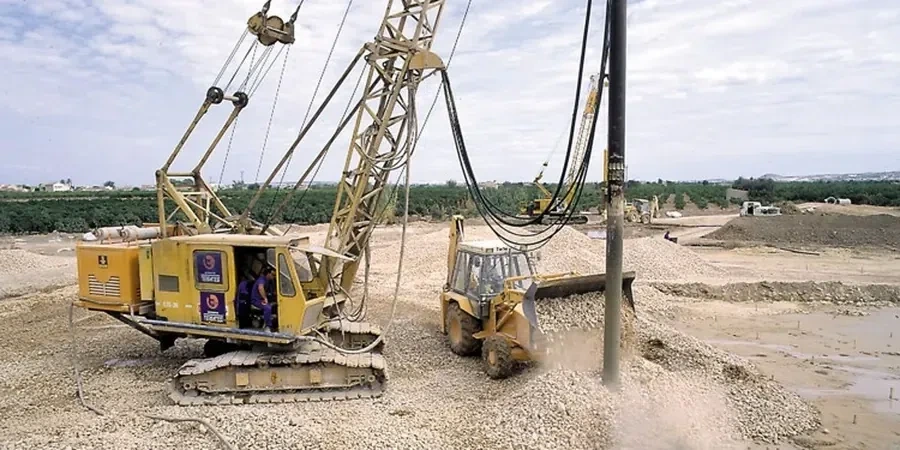
The regulatory framework governing ground improvement in Dundee aligns with Eurocode 7 (BS EN 1997-1:2004+A1:2013 and BS EN 1997-2:2007) and its UK National Annexes, which mandate a limit state design philosophy. Execution standards such as BS EN 14731 for deep vibration and BS EN 12715 for grouting procedures set prescriptive quality control benchmarks. Additionally, Planning Advice Note 69: Planning and Building Standards Advice on Flooding and the Water Environment (Discharge to Ground) Regulations 2017 may influence design where improvement methods interact with groundwater. Adherence to these documents ensures that techniques like prefabricated vertical drain (PVD) design and stone column design are validated through rigorous testing, including post-treatment in-situ penetration tests and load trials.
The types of projects requiring ground improvement in Dundee are diverse. Waterfront regeneration schemes—such as residential and mixed-use developments on the former harbour lands—routinely call for preloading with surcharge design to accelerate consolidation of thick clay layers before construction. Infrastructure upgrades, including road widening and drainage installations over soft ground, often benefit from lime and cement stabilization to create a stable working platform. Industrial facilities with heavy floor loadings or vibration-sensitive equipment may employ vibrocompaction or dynamic compaction to densify loose granular fills. Each project demands a bespoke ground improvement strategy, selected not only for technical efficacy but for programme constraints and environmental considerations such as vibration and noise limits near existing structures.
Available services
Unsaturated soil analysis
→ Ver detalleStone column design
→ Ver detalleDynamic compaction design
→ Ver detallePrefabricated vertical drain (PVD) design
→ Ver detalleJet grouting design
→ Ver detallePreloading with surcharge design
→ Ver detalleVibrocompaction design
→ Ver detalleLime and cement stabilization
→ Ver detalleLandfill geotechnics
→ Ver detalleGeotechnical instrumentation (design and installation)
→ Ver detalleOrganic soil management
→ Ver detalleContaminated soil remediation
→ Ver detalleQuick answers
What is ground improvement and when is it required on a Dundee site?
Ground improvement refers to the controlled modification of soil properties to increase strength, reduce compressibility, or control groundwater flow. In Dundee, it becomes necessary when site investigations reveal soft alluvial clays, loose silts, or uncompacted made ground that cannot meet the bearing capacity or settlement criteria set by Eurocode 7. Indicators include low SPT N-values, undrained shear strengths below 40 kPa, or predicted settlements exceeding structural tolerances.
How do I choose the most suitable ground improvement method for my project?
Method selection depends on soil grain size distribution, depth of treatment, groundwater conditions, and sensitivity to vibration. Cohesive soils typically respond to preloading with drains, stone columns, or lime-cement stabilisation, while granular soils suit vibrocompaction or dynamic compaction. A thorough ground investigation to BS 5930 and a geotechnical risk assessment are prerequisites. The proximity of neighbouring buildings and environmental constraints in Dundee's urban areas also heavily influence the decision.
What are the typical testing and verification requirements after ground improvement?
Verification confirms that design objectives have been met and usually involves a combination of in-situ tests—such as cone penetration tests (CPT), pressuremeter tests, or zone load tests on columns—and laboratory testing of post-treatment samples. Standards like BS EN 14731 specify test frequencies and acceptance criteria. In Dundee, building control may also require settlement monitoring during and after construction to validate performance against predictions.
Does ground improvement eliminate the need for deep foundations in Dundee?
In many cases, yes. Ground improvement can create a reinforced soil mass capable of supporting shallow foundations, avoiding the cost and programme impact of piling. However, this depends on the depth and nature of the weak strata. Where very soft clays extend beyond 15 metres or where structural loads are exceptionally high, a combination of ground improvement and piled foundations may be the most economical solution, assessed on a site-specific basis.